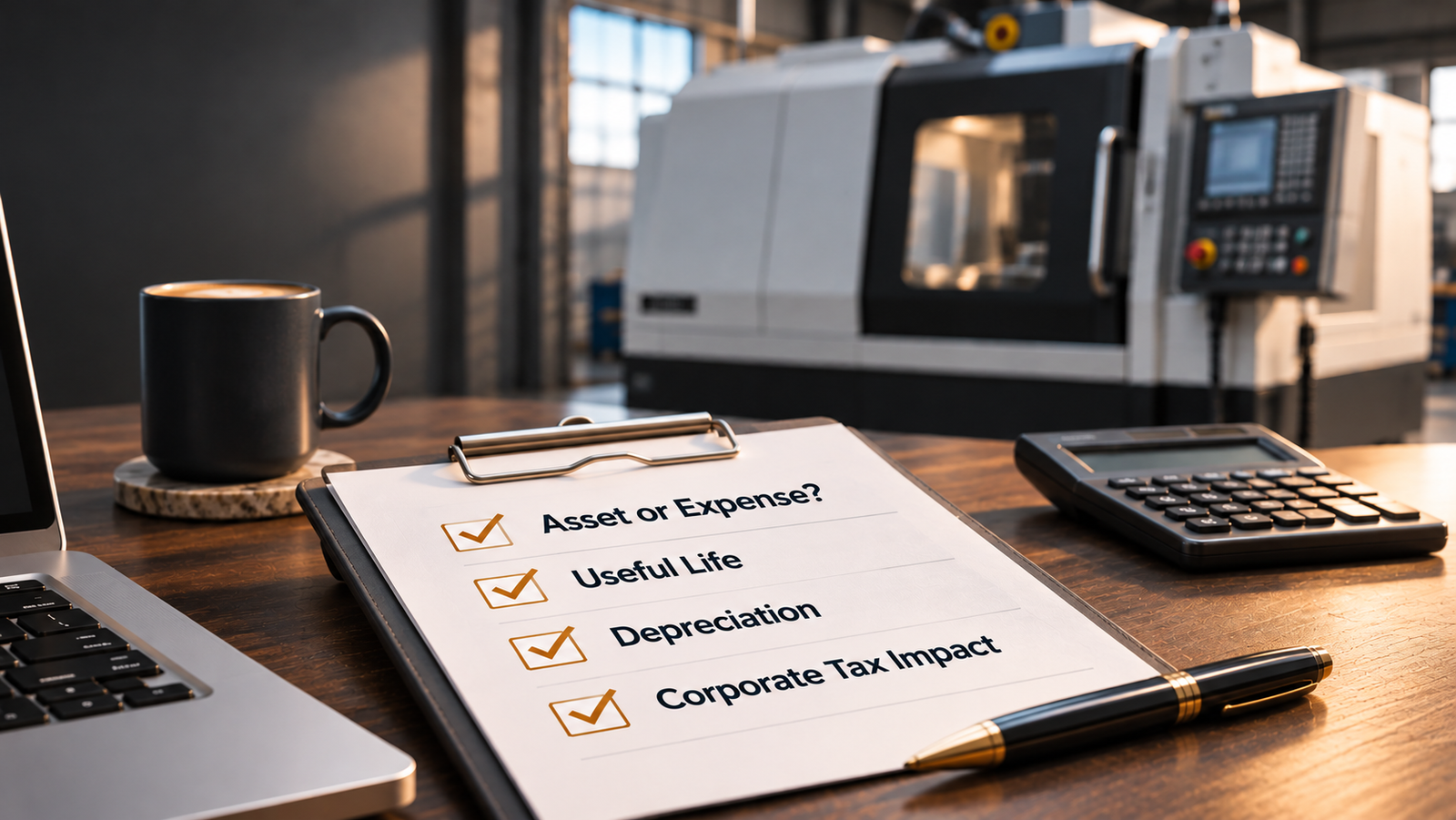

Your UAE Company Bought Equipment. Expense It or Put It on the Balance Sheet?
Your business buys a piece of equipment for AED 120,000.
The payment has left your bank account, so it may feel natural to record the whole AED 120,000 as an expense.
But what if that equipment is going to be used by the business for several years?
That is where the accounting treatment matters. A significant business purchase isn’t automatically an expense simply because cash has been paid. You need to consider what the business actually bought, how it will be used and whether it meets the criteria for recognition as an asset.
Not Every Purchase Is an Immediate Expense
Under IAS 16, an item of property, plant and equipment is recognised as an asset when it is probable that future economic benefits will flow to the business and its cost can be measured reliably. IFRS
So imagine a UAE trading business buys machinery that it expects to use for five years.
The business has not simply “used up” AED 120,000 on the day it bought the machine.
It has acquired an asset that is expected to provide economic benefits over time.
That generally means the cost is recognised as an asset and depreciated over its useful life under the applicable accounting framework.
Capital Expenditure vs Revenue Expenditure
A useful starting point is to distinguish between capital expenditure and ordinary operating expenditure.
Capital expenditure generally relates to acquiring or improving an asset that provides benefits beyond the current period.
Examples could include:
- Machinery
- Production equipment
- Business vehicles
- Major infrastructure
- Certain significant improvements
Revenue expenditure generally relates to the ongoing costs of running the business, such as ordinary repairs, utilities or routine operating expenses.
The exact accounting treatment depends on the nature of the expenditure and the applicable accounting standards.
What Happens After You Capitalise the Asset?
Capitalising an asset doesn’t mean it sits on the balance sheet forever at its original cost.
Under IAS 16, the depreciable amount of an asset is allocated systematically over its useful life. Depreciation generally begins when the asset is available for use. IFRS
For example:
Equipment cost: AED 120,000
Useful life: 5 years
If straight-line depreciation were appropriate and there were no residual value, the illustrative annual depreciation would be:
AED 120,000 ÷ 5 = AED 24,000
That AED 24,000 is very different from recording the full AED 120,000 as an expense in year one.
The actual depreciation method and useful life need to reflect the applicable accounting requirements and circumstances.
What Does This Mean for UAE Corporate Tax?
This is where businesses sometimes make another mistake.
Capital expenditure is generally not treated as an immediate deduction when calculating UAE Taxable Income.
The FTA explains that capital expenditure is generally dealt with through depreciation or amortisation deductions, subject to the Corporate Tax rules. FTA UAE
The UAE Corporate Tax rules also state that expenditure that is capital in nature is determined according to the accounting standards applied by the Taxable Person. وزارة المالية – الإمارات العربية المتحدة
So:
Purchase of capital asset → Capitalise → Depreciate → Consider relevant Corporate Tax treatment
But there is an important qualification: not every accounting depreciation charge is automatically deductible for Corporate Tax purposes. The underlying expenditure still needs to satisfy the relevant tax rules. وزارة المالية – الإمارات العربية المتحدة
Don’t Capitalise Everything Either
The opposite mistake can happen too.
A business may start treating every purchase as an asset simply because it wants to avoid showing a large expense.
That isn’t the right approach.
IAS 16 requires the recognition criteria to be considered for each item, and it also notes that judgement may be needed when determining what constitutes an individual item of property, plant and equipment. IFRS
Your accounting policy and the nature and materiality of the purchase matter.
Ask These Questions Before Recording the Purchase
Before posting a large equipment purchase, ask:
- What did we actually buy?
- Will it provide benefits beyond the current period?
- Does it meet the applicable asset-recognition criteria?
- When will it be available for use?
- What useful life and depreciation method are appropriate?
- What Corporate Tax treatment applies?
Getting these decisions right keeps your financial statements more meaningful and helps prevent accounting and tax treatment from being mixed together.
Frequently Asked Questions
1. Is equipment always treated as a fixed asset?
No. The accounting treatment depends on the nature of the item, whether it meets the applicable recognition criteria and the accounting policies being applied. IFRS
2. What is capital expenditure?
Capital expenditure generally relates to expenditure that is capital in nature, such as acquiring or improving an asset that provides benefits over more than one accounting period.
3. Is capital expenditure deductible immediately for UAE Corporate Tax?
Generally, capital expenditure itself is not immediately deductible. The FTA explains that capital assets are generally recognised through depreciation or amortisation deductions over their economic life, subject to the applicable Corporate Tax rules. FTA UAE
4. When does depreciation start?
Under IAS 16, depreciation begins when the asset is available for use, meaning it is in the location and condition necessary for it to operate as intended. IFRS
5. Can I expense a low-value item instead of capitalising it?
The treatment depends on the applicable accounting standard and the business’s accounting policy. The accounting standards allow judgement in determining what constitutes an individual item of property, plant and equipment. IFRS
6. Is accounting depreciation always deductible for UAE Corporate Tax?
No. The tax treatment needs to be considered under the UAE Corporate Tax rules. The FTA notes that depreciation related to expenditure that would not itself qualify for a deduction may also be non-deductible. FTA UAE
Conclusion
Buying a AED 120,000 machine doesn’t automatically mean your business has incurred a AED 120,000 expense for the period.
The real question is whether the purchase represents an asset that will provide benefits over time and therefore needs to be accounted for accordingly.
Capitalise it, depreciate it and then consider the relevant Corporate Tax treatment.
Getting that classification right gives you more reliable financial statements and helps prevent accounting treatment from being confused with tax treatment.
Bought a Major Asset and Not Sure How It Should Be Recorded?
Evolve Accountants can help review your fixed assets, accounting treatment and relevant Corporate Tax implications so your financial records properly reflect how your business operates.
Evolve Accountants
UAE Tax & Financial Experts