
A customer generates AED 500,000 in sales for your UAE business.
Your team calls them a “key account”. Your sales manager wants to give them another discount. You want to keep them happy.
But there is one number you may not be looking at:
How much profit does this customer actually generate?
Revenue tells you what a customer buys from you. It doesn’t necessarily tell you what the customer costs your business to serve.
For businesses with different customers, pricing arrangements and service requirements, that difference can be significant.
Revenue Isn’t the Same as Customer Profit
Imagine two customers each generate:
AED 500,000 in annual sales.
Customer A places large, regular orders with minimal support.
Customer B requires frequent deliveries, special discounts, repeated revisions and extensive customer-service time.
Their revenue is identical.
Their contribution to your business may not be.
ACCA’s guidance on customer profitability analysis highlights this exact issue: customers that appear valuable based on revenue can turn out to be far less profitable, or even loss-making, once the activities and costs associated with serving them are considered. ACCA Global
Start With What You Can Directly Trace
The first step is not to build a complicated model.
Start with costs you can reasonably connect to the customer.
For example:
Sales revenue
− Discounts
− Product/service costs
− Delivery costs
− Commissions
− Customer-specific support costs
This gives you a clearer view of what that customer contributes before considering broader shared overheads.
The exact costs will depend on your business model.
Then Look at the Cost of Serving Them
This is where businesses often miss the bigger picture.
One customer may require:
- More delivery trips
- More sales visits
- More customer-service calls
- More returns
- More custom work
- More invoicing or administration
Those activities consume resources.
ACCA’s activity-based management guidance explains that customer profitability analysis can use appropriate cost drivers to allocate customer-related overheads more accurately. ACCA Global
The point isn’t to assign every office expense to a customer.
It’s to understand the costs that are actually driven by serving that customer.
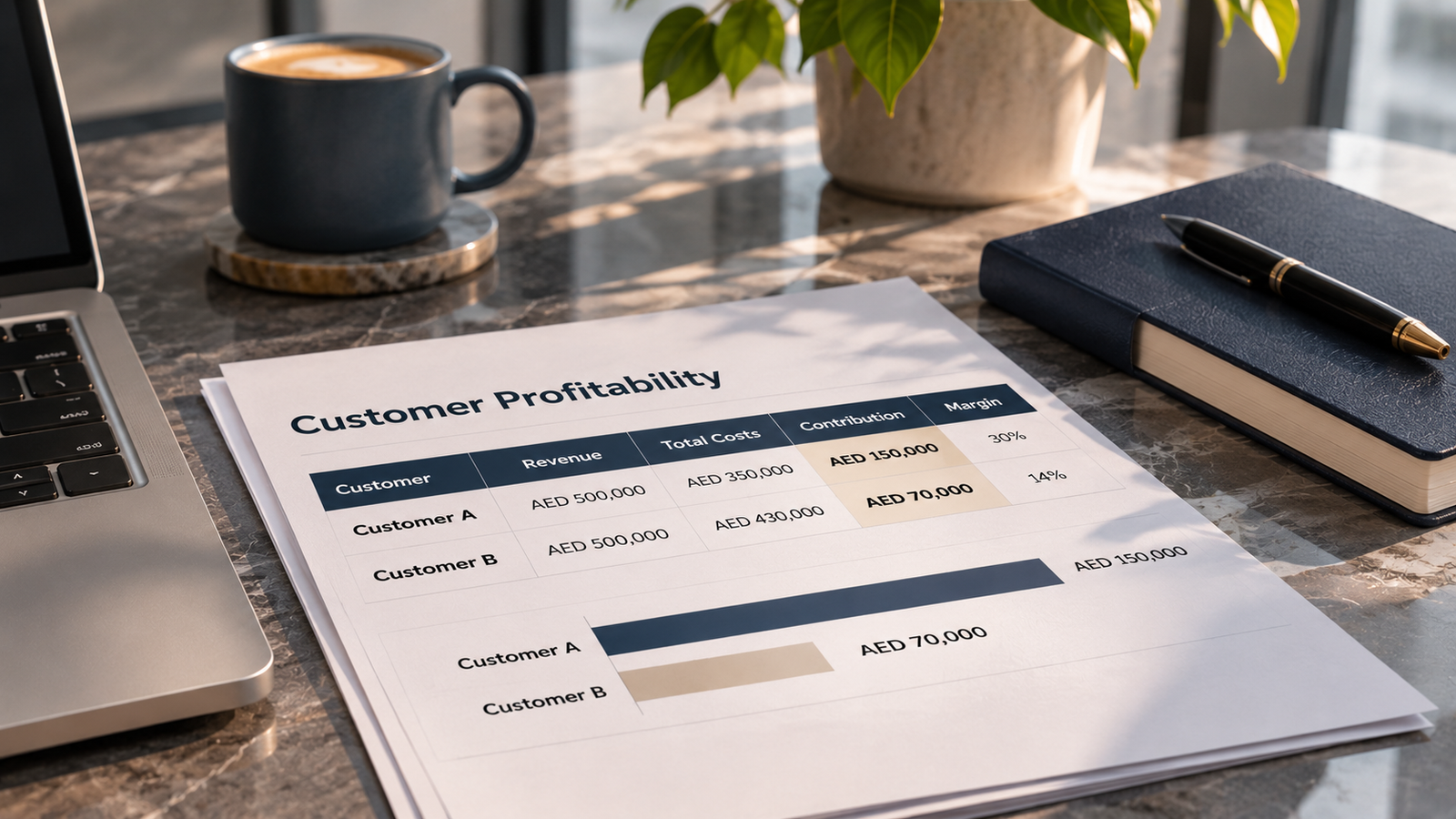
A Simple Example
Suppose Customer A generates:
AED 500,000 revenue
After directly attributable costs, the customer contributes:
AED 150,000
Customer B also generates:
AED 500,000 revenue
But its additional discounts, delivery requirements and support costs reduce its contribution to:
AED 70,000
Looking only at sales, they appear identical.
Looking at the contribution, they’re not.
That difference could change how you approach pricing, service levels and future sales.
Don’t Automatically Drop the “Unprofitable” Customer
A low customer contribution doesn’t automatically mean:
“Fire the customer.”
The analysis is there to support a decision.
You might instead:
- Increase the price
- Reduce discounts
- Change delivery terms
- Reduce unnecessary service costs
- Change the service package
- Set minimum order requirements
Or decide that the customer is strategically important enough to justify the economics.
The important thing is knowing the numbers before making that decision.
What Should Your Management Report Show?
You don’t necessarily need a complicated dashboard.
A useful customer profitability report could show:
Customer → Revenue → Direct costs → Customer-specific costs → Contribution
Then compare customers or customer groups.
IFRS guidance on management reporting emphasises the usefulness of financial and non-financial measures that management actually uses to understand and assess performance. IFRS
The right measures will depend on the business.
The Question Your P&L Doesn’t Answer
Your company’s overall profit tells you how the business performed.
Customer profitability analysis asks a more specific question:
“Which customers are actually contributing to that profit?”
For a growing UAE business, that can be a much more useful question when deciding where to focus sales effort, pricing and resources.
Frequently Asked Questions
1. What is customer profitability analysis?
It is an internal analysis that looks at the revenue generated by a customer alongside the costs associated with serving that customer to understand their contribution to the business.
2. Is the customer with the highest revenue always the most profitable?
No. A high-revenue customer can require significant discounts, delivery, support or other resources that reduce their actual contribution. ACCA specifically identifies cases where apparently valuable customers can turn out to be loss-making after customer-related costs are considered. ACCA Global
3. What costs should be included?
Start with costs that can reasonably be traced or linked to the customer, such as discounts, delivery, commissions and customer-specific service costs. The appropriate costs depend on the business model.
4. Should shared overheads be allocated to every customer?
Not necessarily. If shared costs are allocated, the basis should be reasonable and relevant to how those costs are driven. Activity-based approaches can provide a more detailed view where appropriate. ACCA Global
5. How often should customer profitability be reviewed?
There is no universal frequency. Businesses with significant changes in pricing, customer mix or service requirements may benefit from reviewing it more regularly.
6. Does customer profitability analysis mean I should stop serving low-profit customers?
No. A customer may have strategic value beyond its immediate contribution. The analysis provides information for better decisions; it does not automatically determine the decision.
Conclusion
Your biggest customer isn’t automatically your best customer.
If two customers generate the same revenue but require very different levels of discounts, delivery, support and other resources, their contribution to your business can look completely different.
Revenue tells you who buys from you. Customer profitability analysis helps you understand what they actually contribute.
For a growing UAE business, that can make pricing, sales and resource decisions much more informed.
Want Clearer Numbers Behind Your Customer Decisions?
Evolve Accountantscan help build management reporting that gives you a clearer view of revenue, costs and profitability — helping you understand what your numbers are actually telling you.
Evolve Accountants
UAE Tax & Financial Experts