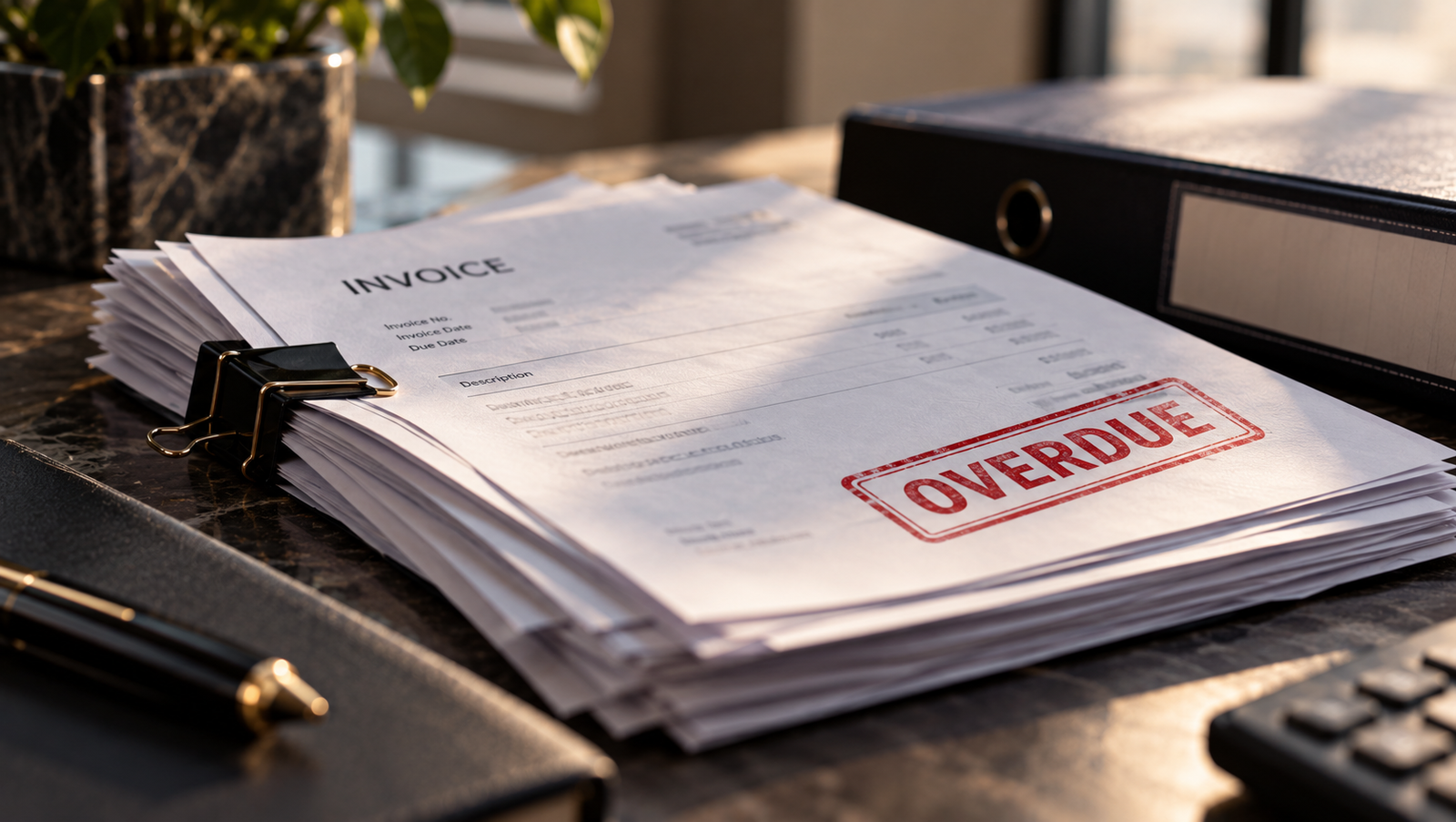

You delivered the work months ago. You raised the invoice. You charged VAT. The customer still hasn’t paid.
At some point, the question changes from “When will they pay?” to “Can we actually write this debt off?”
But writing off an unpaid invoice isn’t simply a matter of deleting it from your accounts. You need to distinguish between the accounting treatment of a bad debt and the separate conditions that apply if you want to adjust the UAE VAT associated with that debt.
An Unpaid Invoice Isn’t Automatically a Bad Debt
An overdue invoice and a bad debt are not necessarily the same thing.
A customer may simply be late. A business might still expect to collect the amount, so immediately writing it off would not necessarily reflect the financial position correctly.
A bad debt is generally a receivable that has been determined to be uncollectable. The FTA’s Corporate Tax guidance explains that a bad debt may result in a provision or a write-off, depending on the circumstances and applicable accounting standards. FTA UAE
So the first question is not:
“How old is the invoice?”
It is:
“Is there a reasonable basis to treat this amount as uncollectable?”
What Happens When You Write Off the Debt?
Suppose your UAE business has an unpaid customer invoice of AED 52,500, including AED 2,500 VAT.
If the receivable is properly determined to be uncollectable and written off under the applicable accounting framework, the accounting records need to reflect that write-off.
But don’t stop there.
If VAT was charged on the original supply, you may also need to consider whether the separate UAE VAT bad-debt relief conditions have been met.
VAT Has Its Own Conditions
Under Article 64 of the UAE VAT Decree-Law, a VAT-registered supplier may reduce its output tax for a bad debt where the specified conditions are satisfied. These include:
- The goods or services were supplied and VAT was charged and accounted for.
- The consideration has been written off in full or part as a bad debt in the supplier’s accounts.
- More than six months have passed from the date of supply.
- The supplier has notified the customer of the amount written off. FTA UAE
So:
Unpaid invoice ≠ automatic VAT relief.
The conditions need to be checked.
The FTA also explains that the VAT adjustment is made in the relevant Adjustment field of the VAT return, and the adjustment relates to the VAT amount rather than the full value of the bad debt. FTA UAE
Don’t Confuse the Invoice Value With the VAT Adjustment
Using the earlier example:
Invoice: AED 52,500
VAT: AED 2,500
Amount written off: AED 52,500
If all the Article 64 conditions are satisfied, the VAT adjustment relates to the AED 2,500 VAT, not the full AED 52,500 receivable. FTA UAE
That distinction is important when preparing the VAT return.
What Should Your Business Keep?
If you’re treating a customer balance as a bad debt, your records should support what happened.
Keep relevant evidence such as:
- Original invoice
- Customer correspondence
- Collection attempts
- Accounting entry showing the write-off
- Evidence of customer notification where required
The exact records will depend on the circumstances, but the underlying principle is simple:
Your accounts should be able to explain why the debt was considered uncollectable and how the VAT treatment was determined.
What About UAE Corporate Tax?
The accounting write-off can also have Corporate Tax implications.
The FTA states that where a bad-debt write-off is made in accordance with the relevant accounting standards, the expense may be deductible when determining Taxable Income, provided it satisfies the Corporate Tax Law’s deductibility requirements. If a previously written-off amount is later recovered, the resulting accounting income may be taxable in the relevant Tax Period. FTA UAE
So an unpaid invoice can have three separate considerations:
Accounting treatment → VAT treatment → Corporate Tax treatment
They should not be treated as one issue.
Frequently Asked Questions
1. Can I write off an unpaid invoice immediately?
Not simply because it is overdue. The business needs to determine whether the receivable is genuinely uncollectable under the applicable accounting framework and circumstances.
2. How long before I can claim UAE VAT bad-debt relief?
One of the Article 64 conditions is that more than six months must have passed from the date of supply, along with the other specified conditions. FTA UAE
3. Do I get back the full invoice amount through VAT relief?
No. The VAT adjustment relates to the VAT associated with the amount written off, not the full invoice value. FTA UAE
4. Do I have to notify the customer?
Yes. Notification of the amount of consideration written off is one of the conditions for the supplier’s bad-debt relief under Article 64. FTA UAE
5. What if the customer eventually pays after the debt was written off?
The accounting and tax treatment of the recovery needs to be considered when the amount is subsequently recognised. The FTA’s Corporate Tax guidance notes that a recovery of a previously written-off bad debt can result in taxable income in the relevant Tax Period. FTA UAE
6. Is every overdue invoice a bad debt?
No. An overdue receivable is not automatically uncollectable. The business needs to assess the circumstances and apply the appropriate accounting treatment.
Conclusion
An unpaid invoice shouldn’t simply sit in your accounts forever, but it also shouldn’t be written off just because a customer is late.
For UAE businesses, the important distinction is between identifying a genuine bad debt, recording the accounting write-off correctly, and checking whether the separate VAT relief conditions are satisfied.
If a significant customer balance has become difficult to collect, review the accounting, VAT and Corporate Tax implications before simply removing it from your books.
Have Unpaid Invoices Sitting on Your Books?
Evolve Accountants can help review your receivables, accounting treatment and relevant VAT records so bad debts are handled properly and supported by the right documentation.
Evolve Accountants
UAE Tax & Financial Experts