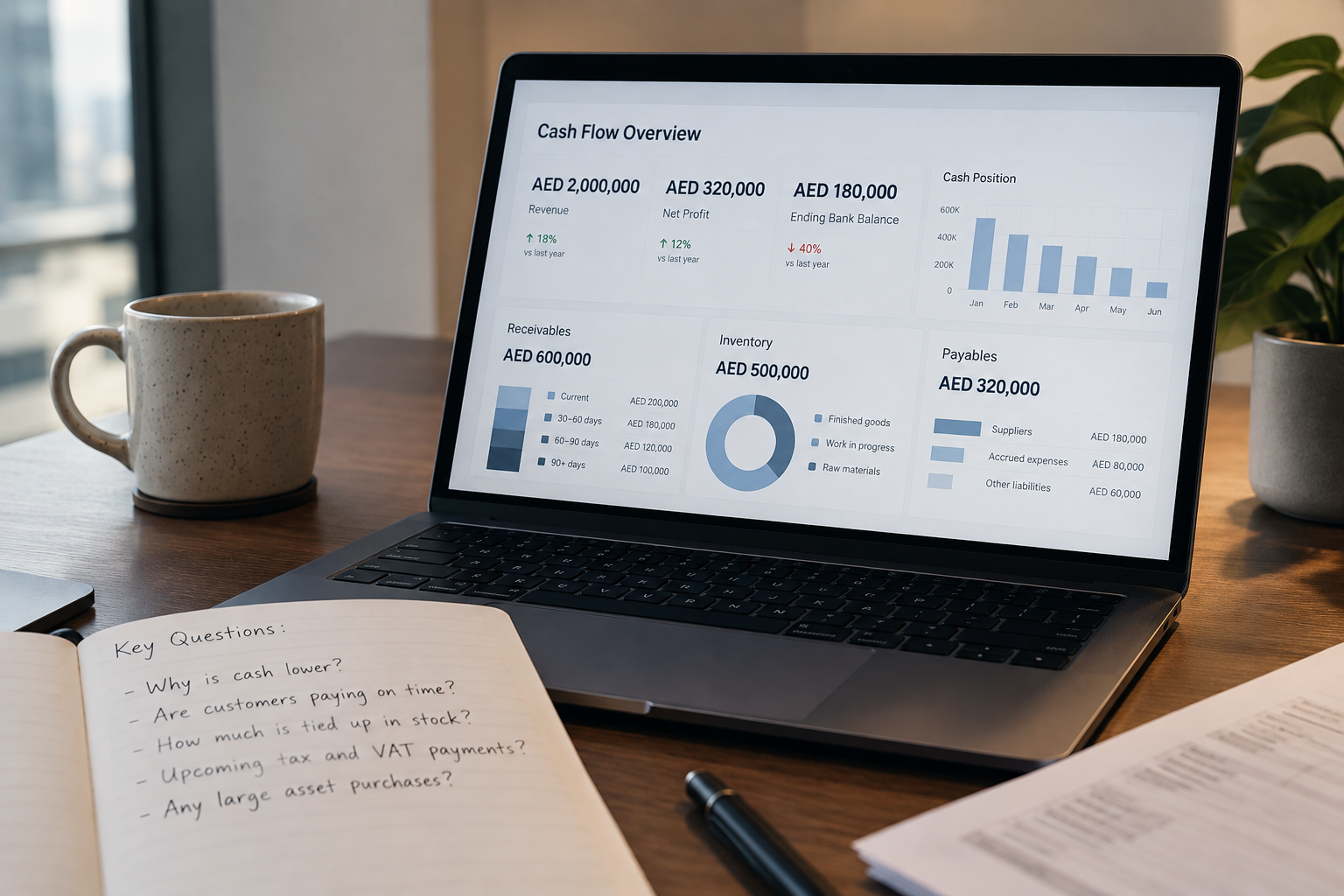

Your UAE business generated AED 2 million in revenue this year.
Sales are growing. Customers are coming in. Your accounts even show a profit.
But your bank balance keeps getting smaller.
So where is the money going?
This is one of the most confusing problems for business owners because revenue, profit and cash are not the same thing.
You can make a sale today and wait months for payment. You can be profitable while cash is tied up in inventory. You can also have money in the bank that is already needed for suppliers, payroll, VAT, Corporate Tax or loan repayments.
The real question isn’t:
“Why aren’t we making enough sales?”
It’s:
“Why aren’t our sales turning into cash?”
Revenue Is Not the Same as Cash
Imagine your business generates:
AED 2,000,000 revenue
But at year end:
AED 600,000 is still owed by customers.
Your P&L may show strong revenue and profit, but AED 600,000 has not yet been collected.
That’s why business owners need to look at profitability and cash flow separately.
For UAE Corporate Tax purposes, accounting net profit or loss generally forms the starting point for determining taxable income, with applicable adjustments then made under the Corporate Tax rules. That is very different from simply looking at the cash sitting in your bank account.
7 Reasons Your Bank Balance Could Be Falling
1. Customers Are Taking Too Long to Pay
You make the sale.
You issue the invoice.
You record the revenue.
But the customer pays 30, 60 or 90 days later.
For example, your business generates AED 3 million in annual revenue, but your average collection period increases from 30 days to 60 days.
Your sales haven’t necessarily fallen.
But more of your cash is now sitting in accounts receivable.
Track:
- Total receivables
- Overdue invoices
- Average collection period
- 90+ day balances
If revenue grows 20% but receivables grow 50%, your sales growth may actually be creating a working capital problem.
2. Too Much Cash Is Sitting in Inventory
Revenue can increase while cash disappears into stock.
Imagine a trading or e-commerce business generates:
AED 1.5M in sales
but spends:
AED 500K purchasing additional inventory.
The cash has left the bank, but some of the stock may still be sitting in the warehouse.
This creates a common cycle:
More sales → more inventory → more cash tied up
Review:
- Inventory value
- Inventory turnover
- Slow-moving stock
- Obsolete stock
- Stock purchased versus sold
Sometimes a business doesn’t have a cash problem because it is unprofitable.
It has a cash problem because too much money is trapped in inventory.
3. You’re Paying Suppliers Before Customers Pay You
Suppose:
Supplier terms: 30 days
Customer payment terms: 60 days
That creates a 30-day working capital gap.
As the business grows, the amount of cash tied up in that gap can grow too.
Monitor:
Receivable Days vs Payable Days
If you’re consistently collecting much slower than you’re paying suppliers, increasing revenue can actually increase pressure on cash.
4. Payroll and Operating Costs Are Growing Too Quickly
Growth often means more:
- Salaries
- Recruitment
- Office costs
- Software
- Marketing
- Insurance
- Professional services
Imagine:
Before expansion
Revenue: AED 2M
Payroll: AED 400K
After expansion
Revenue: AED 2.4M
Payroll: AED 650K
Revenue increased by AED 400K, but payroll increased by AED 250K.
And if part of that additional revenue is still sitting in receivables, the business may have increased its costs before receiving the cash to support them.
Growth should strengthen the business, not simply make it bigger.
5. Debt Repayments Are Reducing Your Cash
Loan repayments can reduce your bank balance even when the business remains profitable.
For example:
Net profit: AED 200K
Loan principal repaid: AED 150K
The profit figure and cash movement are not the same.
That’s why management should monitor:
- Outstanding loans
- Principal repayments
- Interest
- Upcoming instalments
- Short term liabilities
Don’t only ask:
“How much debt do we have?”
Ask:
“How much cash will our debt require over the next 12 months?”
6. Tax and Other Liabilities Are Using Your Cash
Seeing AED 300,000 in the bank doesn’t necessarily mean AED 300,000 is available to spend.
Part of that cash may already be needed for:
- VAT obligations
- Corporate Tax
- Payroll
- Supplier payments
- Accrued expenses
- Loan commitments
This is why cash flow forecasting should consider future obligations, not just today’s bank balance.
VAT and Corporate Tax are separate UAE tax obligations where applicable, so businesses should plan for each liability separately.
7. You’re Spending Cash on Assets and Investments
A profitable business can still see its bank balance fall because of large purchases.
For example:
Equipment purchase: AED 250K
The bank balance falls by AED 250K.
But accounting treatment may involve recording an asset and recognising depreciation over time rather than treating the full purchase price as an immediate operating expense.
The same principle can apply to:
- Vehicles
- Machinery
- Office fit-outs
- Technology
- Business acquisitions
- Large deposits
This is why your P&L alone cannot explain every movement in your bank account.
When Business Growth Starts Consuming Cash
Consider this example:
| Before | After | |
| Revenue | AED 2M | AED 3M |
| Gross Profit | AED 800K | AED 1.1M |
| Net Profit | AED 250K | AED 350K |
| Receivables | AED 300K | AED 700K |
| Inventory | AED 200K | AED 450K |
| Payroll | AED 400K | AED 600K |
Everything looks better.
Revenue increased.
Gross profit increased.
Net profit increased.
But significantly more cash is now tied up in receivables and inventory, while payroll has also increased.
The business isn’t necessarily failing.
It may simply be growing faster than its cash position can support.
The 5 Numbers You Should Watch Every Month
Don’t look at the bank statement alone.
Track:
1. Cash Balance
How much cash is actually available?
2. Accounts Receivable
How much money is still with customers?
3. Accounts Payable
How much do you owe suppliers?
4. Operating Cash Flow
Is the core business actually generating cash?
5. Cash Runway
How long could the business continue operating with its available cash?
These numbers can reveal financial pressure long before it becomes an emergency.
How to Improve Cash Flow
Speed Up Collections
Monitor overdue invoices, set clear payment terms and follow up before invoices become significantly overdue.
Control Inventory
Purchase according to demand and identify slow-moving stock before too much cash becomes trapped.
Review Supplier Terms
Where commercially possible, negotiate payment terms that better match your customer collection cycle.
Forecast Cash Flow
Look ahead at least 30, 60 and 90 days to identify upcoming shortages before they happen.
Review Profit and Cash Together
Your:
P&L tells you about profitability.
Balance Sheet shows what the business owns and owes.
Cash Flow Statement shows movements in cash.
You need all three to understand the financial position properly.
The Questions Business Owners Should Be Asking
Instead of asking only:
“How much profit did we make?”
also ask:
- How much cash did the business generate?
- How much is still owed by customers?
- How much cash is tied up in inventory?
- How much do we owe suppliers?
- What liabilities are coming due?
- How much cash will we need over the next 90 days?
These questions tell you whether revenue is actually strengthening your business.
Frequently Asked Questions
1. Why is my UAE business profitable but my bank balance decreasing?
A business can be profitable while cash falls because money may be tied up in receivables, inventory, capital expenditure, debt repayments or other working capital requirements.
2. Can revenue increase while cash flow decreases?
Yes. If customers take longer to pay, inventory increases, operating costs rise or the business makes significant investments, revenue can increase while cash flow deteriorates.
3. What is the difference between revenue and cash flow?
Revenue represents income generated from business activity under the applicable accounting basis. Cash flow measures the actual movement of money into and out of the business.
4. How can I improve cash flow in my UAE business?
Focus on customer collections, inventory management, supplier terms, operating costs and regular cash flow forecasting.
5. How often should a UAE business review cash flow?
Monthly is a useful baseline for many businesses. Companies experiencing rapid growth, large receivables or significant cash commitments may need more frequent monitoring.
6. Does UAE Corporate Tax depend on my bank balance?
No. UAE Corporate Tax is not simply calculated based on the money in your bank account. Taxable income generally starts with accounting net profit or loss and is then adjusted under the applicable Corporate Tax rules.
7. Can a UAE business use cash basis accounting?
Generally, businesses use the accrual basis unless permitted to use the cash basis. For Corporate Tax purposes, cash basis accounting can be used where revenue does not exceed AED 3 million for the relevant Tax Period, subject to the applicable rules.
Conclusion
A falling bank balance doesn’t necessarily mean your UAE business has a revenue problem. You may have a cash conversion or working capital problem. Customers may be paying slowly, inventory may be absorbing cash, costs may be growing too quickly, or debt and investment may be consuming available funds. Revenue tells you what the business generated, profit tells you how it performed under the applicable accounting rules, and cash flow tells you what money actually moved. If those three stories don’t match, your financial reporting deserves a closer look.
Your Revenue Is Growing. But Is Your Cash?
At Evolve Accountants, we help UAE businesses understand where their cash is going through accurate bookkeeping, financial reporting, receivables and payables analysis, working capital reviews and cash flow management.
If your revenue is growing but your bank balance keeps falling, a financial review can help identify where cash is being tied up and what needs to change.
Evolve Accountants
UAE Tax & Financial Experts