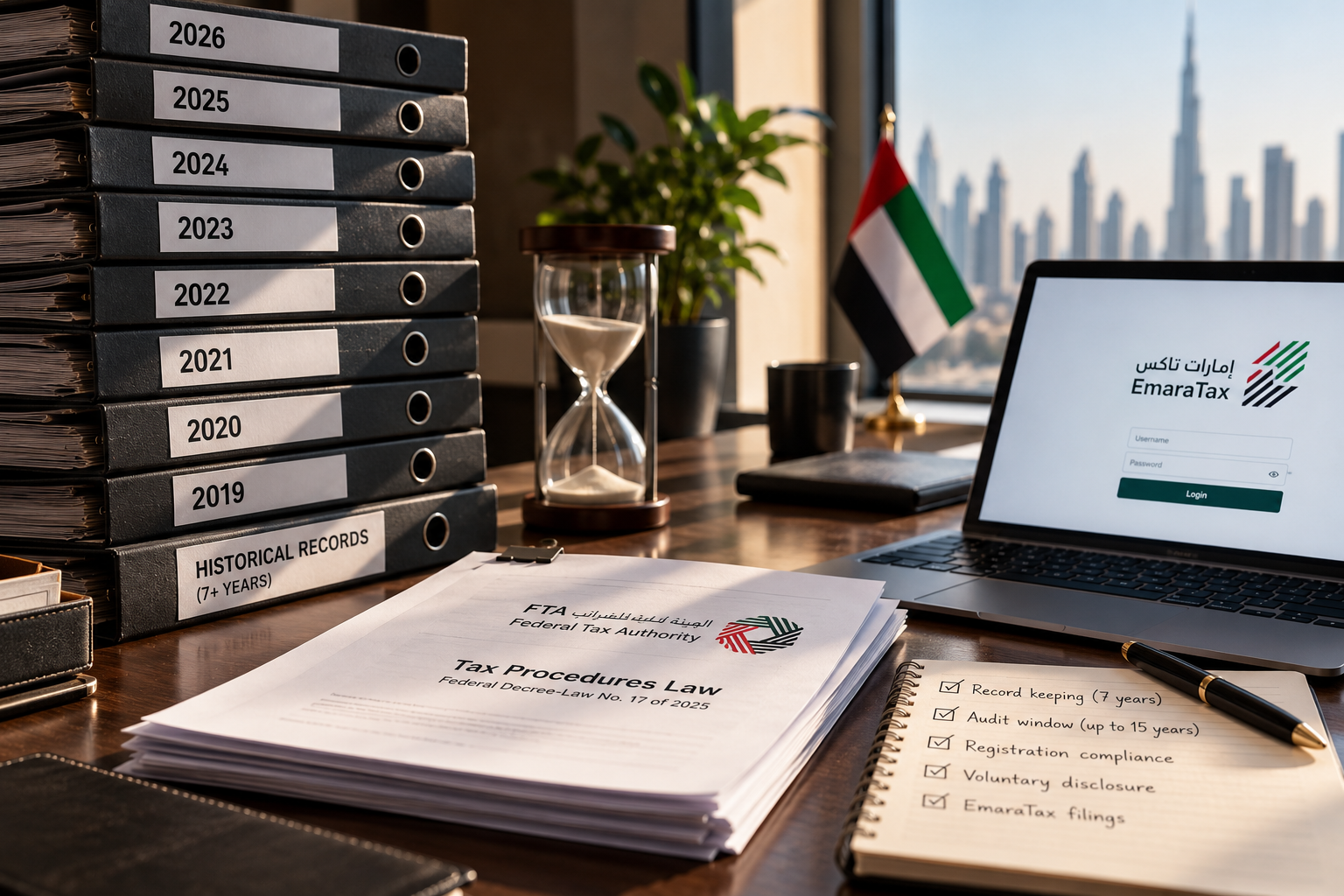

If you think UAE tax compliance stops at filing your annual corporate tax or VAT return on EmaraTax, think again.
With the implementation of updated regulatory frameworks including sweeping amendments under the overhauled Tax Procedures Law (driven by Federal Decree Law No 17 of 2025), the Federal Tax Authority (FTA) has dramatically strengthened its enforcement powers.
While business owners have focused heavily on registration deadlines and tax thresholds, a quieter, more critical operational shift is catching unprepared companies off guard: drastically extended audit windows, stricter record-keeping enforcement, and automated data-matching across multiple tax types.
1. The 15-Year Audit Window: When 5 Years No Longer Applies
Historically, businesses operated under the assumption that the statute of limitations for a tax audit was capped at five years. Once you cleared that window, your historical files were safely behind you.
Under the updated framework, that rule has fundamentally changed:
- The Standard Rule: A five-year limitation period generally applies to standard tax audits and assessments.
- The 15-Year Extension: In specific, high-risk scenarios most notably tax evasion or failing to register for tax purposes, the FTA’s window to investigate, audit, and assess liabilities can now extend up to 15 years (calculated from the date the business was legally required to register).
- The Real-World Impact: Delaying your mandatory corporate tax or VAT registration isn’t just an immediate AED 10,000 fine; it actively strips away your statutory protections, exposing your business books to multi-decade scrutiny.
2. How the FTA Triggers Audits (Desk Audits vs Field Reviews)
Many founders assume the FTA only flags companies that look suspicious on paper. In reality, modern FTA oversight relies heavily on automated digital matching inside EmaraTax.
Cross-referencing your VAT returns against your Corporate Tax filings, or logging frequent data inconsistencies, can automatically trigger a review.
For example, if a company’s reported revenues on EmaraTax do not match bank statements or import declarations during a routine data cross-check, the FTA frequently initiates a targeted desk audit.
These audits usually begin with a digital notice requiring strict, time-sensitive document uploads through the portal. If books are messy, missing, or unsupported by proper invoices, a minor reporting discrepancy can quickly escalate into a comprehensive field investigation.
3. The 7-Year Record-Keeping Mandate is Now Non-Negotiable
Because the FTA can look back up to 15 years under breach conditions, maintaining immaculate historical paper trails is essential.
- The Rule: UAE businesses are legally required to retain all accounting records, financial statements, invoices, and supporting documents for at least 7 years following the end of each tax period.
- The Trap: Throwing away receipts, failing to link invoices to bank statements, or relying on disorganized bookkeeping leaves you completely defenseless if the FTA requests historical verification. Under UAE tax law, the burden of proof rests entirely on the taxpayer. If you cannot produce the records, you lose the argument by default.
4. Voluntary Disclosures and Correcting Errors
The updated tax procedures also tighten how mistakes are handled.
If you discover an error or omission in a previously submitted tax return that affects your tax liability, you cannot simply fix it quietly in the next filing cycle. You are required to formally correct the error by submitting a Voluntary Disclosure (VD) through EmaraTax. Proactively fixing errors via a VD significantly mitigates administrative penalties compared to waiting for the FTA to uncover them during an audit.
Frequently Asked Questions
1. How long do I need to keep my business financial records in the UAE?
You must retain all financial books, invoices, and supporting documents for at least 7 years from the end of the relevant tax period.
2. Can the FTA audit transactions older than 5 years?
Yes. While 5 years is the standard cap, the FTA can extend audit and assessment periods up to 15 years in cases involving deliberate non-compliance, tax evasion, or failure to register for tax.
3. What happens if I find a mistake in a submitted tax return?
If the error impacts the tax due amount, you must correct it by filing a formal Voluntary Disclosure through the EmaraTax portal.
4. Does the 15-year rule apply to standard, fully compliant businesses?
No. The extended 15-year window specifically targets high-risk scenarios such as tax evasion or deliberate failure to register, whereas standard compliant audits typically adhere to the 5-year framework.
5. Are free zone companies subject to these audit and record-keeping rules?
Yes. All federal tax laws and procedural rules apply uniformly across both mainland and free zone entities operating within the UAE.
6. What is the penalty for failing to provide records during an FTA audit?
Failing to maintain records or refusing to supply requested documents to tax auditors triggers severe administrative penalties starting at AED 10,000 for initial offences, leaving businesses defenseless against arbitrary tax assessments.
Conclusion
The evolution of the UAE tax environment shows a clear regulatory trend: the FTA is rewarding clean, transparent, and proactive compliance while heavily penalizing disorganization and deliberate avoidance. Keeping your records structured and addressing registration duties immediately is the only way to safeguard your business.
Is Your Business Audit-Ready?
At Evolve Accountants, we help UAE companies clean up their historical books, establish bulletproof 7-year record retention protocols, and ensure complete alignment with the latest FTA guidelines.
Book a Tax Compliance and Record Audit with Evolve Accountants today.
Evolve Accountants
UAE Tax & Financial Experts