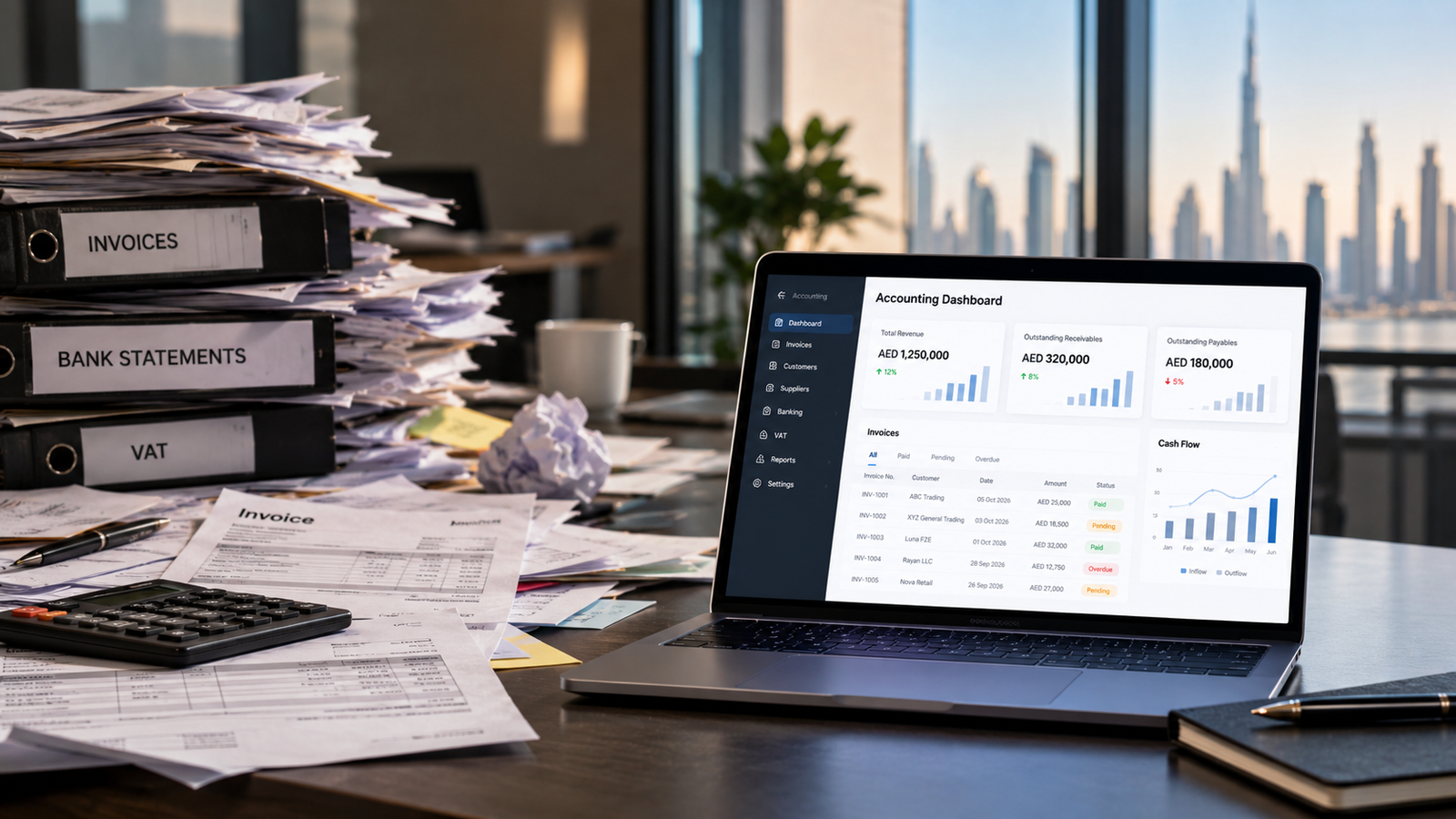

If your accounting still depends heavily on Excel sheets, emailed invoices, manual data entry and last minute reconciliations, 2027 may expose weaknesses you’ve been able to overlook.
The UAE is moving toward a more digital financial environment, with E-Invoicing becoming a major part of that transition.
Businesses with annual revenue of AED 50 million or more are scheduled for mandatory E-Invoicing implementation from 1 January 2027. Businesses below AED 50 million are scheduled for implementation from 1 July 2027, subject to the applicable scope and exclusions.
But here’s what many business owners misunderstand:
Buying accounting software does not automatically make your accounting system ready.
Your invoices, customer data, VAT records, reconciliations, reporting and internal controls all need to work together.
What Does “Ready for 2027” Actually Mean?
A ready accounting system should help your business:
- Record transactions accurately
- Reconcile bank accounts regularly
- Track receivables and payables
- Maintain reliable VAT records
- Produce financial reports on time
- Reduce unnecessary manual data entry
- Maintain complete customer and supplier information
- Support applicable E-Invoicing requirements
The UAE defines an E-Invoice as structured invoice data issued and exchanged electronically and reported through the applicable framework. A PDF, Word document, image, scan or email is not an E-Invoice simply because it was sent electronically.
So the real question isn’t:
“Do we have accounting software?”
It’s:
“Can our entire finance process produce accurate, structured and reliable data?”
10 Signs Your Accounting System Needs an Upgrade
1. Excel Is Doing Too Much of the Work
Excel isn’t automatically a problem.
The problem starts when sales, expenses, VAT, payroll and management reporting all depend on separate spreadsheets.
That creates risks such as:
- Duplicate entries
- Missing transactions
- Formula errors
- Inconsistent figures
- Delayed reporting
If your accounting software says one thing and your spreadsheet says another, your process needs attention.
2. Your Invoices Are Only PDFs
A PDF invoice may look perfectly professional, but it does not automatically qualify as an eInvoice.
The UAE E-Invoicing framework requires structured electronic invoice data.
If your process is still:
Create invoice → Save PDF → Email customer
don’t assume you’re already prepared.
Your underlying technology and data flow matter.
3. Bank Reconciliation Is Always Behind
Ask:
“Are all our bank accounts reconciled up to the latest month?”
If the answer is always “we’re working on it,” that’s a warning sign.
Regular reconciliation helps identify:
- Missing transactions
- Duplicate payments
- Bank fees
- Unidentified receipts
- Accounting errors
Your financial reports are only as reliable as the transactions behind them.
4. You Can’t Produce a Reliable P&L Quickly
Ask your finance team:
“What was our net profit last month?”
If it takes several days of spreadsheet work to answer, management is working with outdated information.
You should have timely visibility over:
- Revenue
- Gross profit
- Net profit
- Receivables
- Payables
- Cash flow
Financial reporting should support decisions, not simply document the past.
5. Customer and Supplier Data Is Incomplete
E-Invoicing readiness isn’t only about the invoice itself.
Your business should also review the quality of its:
- Customer details
- Supplier records
- Tax information
- Invoice data
- Payment terms
- Credit notes
Poor data can create problems when more processes become automated.
6. Your VAT Records Don’t Match Your Accounts
Your VAT reporting and accounting records should tell the same story.
If your finance team has to manually adjust figures every time a VAT return is prepared, investigate why.
Review:
- Output VAT
- Input VAT
- Credit notes
- Taxable supplies
- Zero-rated and exempt transactions
The goal isn’t simply to file the VAT return.
It’s to know that the figures can be traced back to the underlying accounting records.
7. You Don’t Know Who Owes You Money
If you need to message your accountant every time you want to know your outstanding receivables, your system isn’t giving management enough visibility.
You should be able to quickly see:
Total receivables
Current balances
30 to 60 day balances
60 to 90 day balances
90+ day balances
Sales are not the same as collections.
8. Your Expenses Are Poorly Categorised
If management cannot quickly answer:
- How much did we spend on marketing?
- Which costs increased?
- How much are we spending on software?
- Where are our biggest expenses?
your chart of accounts may need restructuring.
Good accounting doesn’t just record expenses.
It classifies them in a way that helps management make better decisions.
9. Your Systems Don’t Talk to Each Other
Depending on your business, accounting may need to connect with:
- Payment gateways
- E-commerce platforms
- Payroll
- Inventory systems
- POS systems
- CRM platforms
- Banking and expense tools
Every unnecessary manual transfer of data creates another opportunity for error.
Automation should reduce repetitive work while giving your finance team more time to analyse the numbers.
10. Financial Reports Still Take Days to Prepare
Here’s perhaps the simplest test.
Ask:
“If I wanted our latest P&L, Balance Sheet, receivables, payables and cash position today, how long would it take?”
If the answer is several days, your accounting process may need improvement.
A strong system should make financial information:
- Accurate
- Accessible
- Consistent
- Traceable
- Useful
The 2027 E-Invoicing Timeline
The UAE E-Invoicing rollout is phased.
Revenue of AED 50M or More
Mandatory implementation: 1 January 2027
The ASP appointment deadline for businesses in this category was extended from 31 July 2026 to 30 October 2026. The implementation date remains unchanged.
Revenue Below AED 50M
ASP appointment: 31 March 2027
Mandatory implementation: 1 July 2027
Businesses can also voluntarily implement E-Invoicing from 1 July 2026.
The system applies to transactions within its scope, with specific exclusions. B2C transactions are currently excluded under the applicable rules unless and until otherwise determined.
Don’t Make the Mistake of Just Buying Software
A new accounting platform won’t fix:
Bad data
Poor processes
Weak reconciliations
Incorrect classifications
Incomplete customer records
You can automate a bad process.
You’ll simply get bad results faster.
A better approach is:
1. Clean your accounting data
2. Review your finance processes
3. Standardize transaction recording
4. Check VAT and tax treatment
5. Reduce unnecessary manual work
6. Assess E-Invoicing requirements
7. Improve monthly financial reporting
Then choose technology that supports the process.
Your 2027 Accounting Readiness Check
Ask yourself:
| Area | Ready? |
| Bank accounts reconciled regularly | ☐ |
| Receivables and payables tracked | ☐ |
| VAT records reconciled | ☐ |
| Customer and supplier data complete | ☐ |
| Financial reports available monthly | ☐ |
| Chart of accounts properly structured | ☐ |
| Invoice numbering controlled | ☐ |
| Credit notes recorded correctly | ☐ |
| Manual spreadsheet dependency reduced | ☐ |
| E-Invoicing readiness assessed | ☐ |
If several boxes remain unchecked, the problem may not simply be your software.
It may be your accounting process.
Why This Matters Beyond E-Invoicing
It would be easy to think:
“2027 is just about E-Invoicing.”
It isn’t.
The broader shift is toward cleaner, structured and more accessible financial data.
Businesses that improve their accounting systems can gain:
- Faster reporting
- Better cash-flow visibility
- Fewer manual errors
- Easier reconciliations
- Stronger financial controls
- Better management decisions
The businesses that prepare early won’t just be more compliant.
They’ll have better information to run the business.
Frequently Asked Questions
1. What is E-Invoicing in the UAE?
E-Invoicing involves structured electronic invoice data being issued and exchanged electronically and reported through the UAE’s E-Invoicing framework. A PDF, Word document, image or scanned invoice does not qualify simply because it was sent electronically.
2. When does UAE E-Invoicing become mandatory?
Businesses with annual revenue of AED 50 million or more are scheduled for mandatory implementation from 1 January 2027. Businesses below AED 50 million are scheduled for implementation from 1 July 2027, subject to the applicable scope and exclusions.
3. Do smaller UAE businesses need to prepare?
Yes, businesses below AED 50 million that fall within the applicable scope are scheduled for implementation from 1 July 2027 and must appoint an ASP by 31 March 2027.
4. Is accounting software the same as an E-Invoicing system?
No. Your accounting software and E-Invoicing setup are related but not necessarily the same. Your systems need to support the applicable technical, data and reporting requirements.
5. Can I continue using Excel?
Excel can still be useful for analysis and supporting calculations. However, relying heavily on spreadsheets for core accounting can create data, reconciliation and reporting risks as the business grows.
6. Should I replace my accounting software before 2027?
Not necessarily. First assess your existing system, processes, transaction volume, integrations and E-Invoicing requirements. The right solution depends on your business.
Conclusion
2027 is more than an E-Invoicing deadline. It is a good opportunity for UAE businesses to examine whether their accounting processes can keep up with a more digital financial environment. The businesses that prepare properly won’t simply be the ones that buy new software. They’ll be the ones with clean data, reliable processes, accurate reporting and stronger financial controls.
So ask yourself:
“If my business doubled its transactions tomorrow, would my accounting system cope?”
If the answer is no, now is the time to fix the process.
Is Your Accounting System Ready for 2027?
At Evolve Accountants, we help UAE businesses improve their bookkeeping, financial reporting, accounting processes and financial controls so their numbers are accurate, accessible and ready for growth.
Whether you need to improve your monthly reporting, clean up your accounts, review your accounting processes or assess your E-Invoicing readiness, our team can help you identify what needs to change.
Evolve Accountants
UAE Tax & Financial Experts