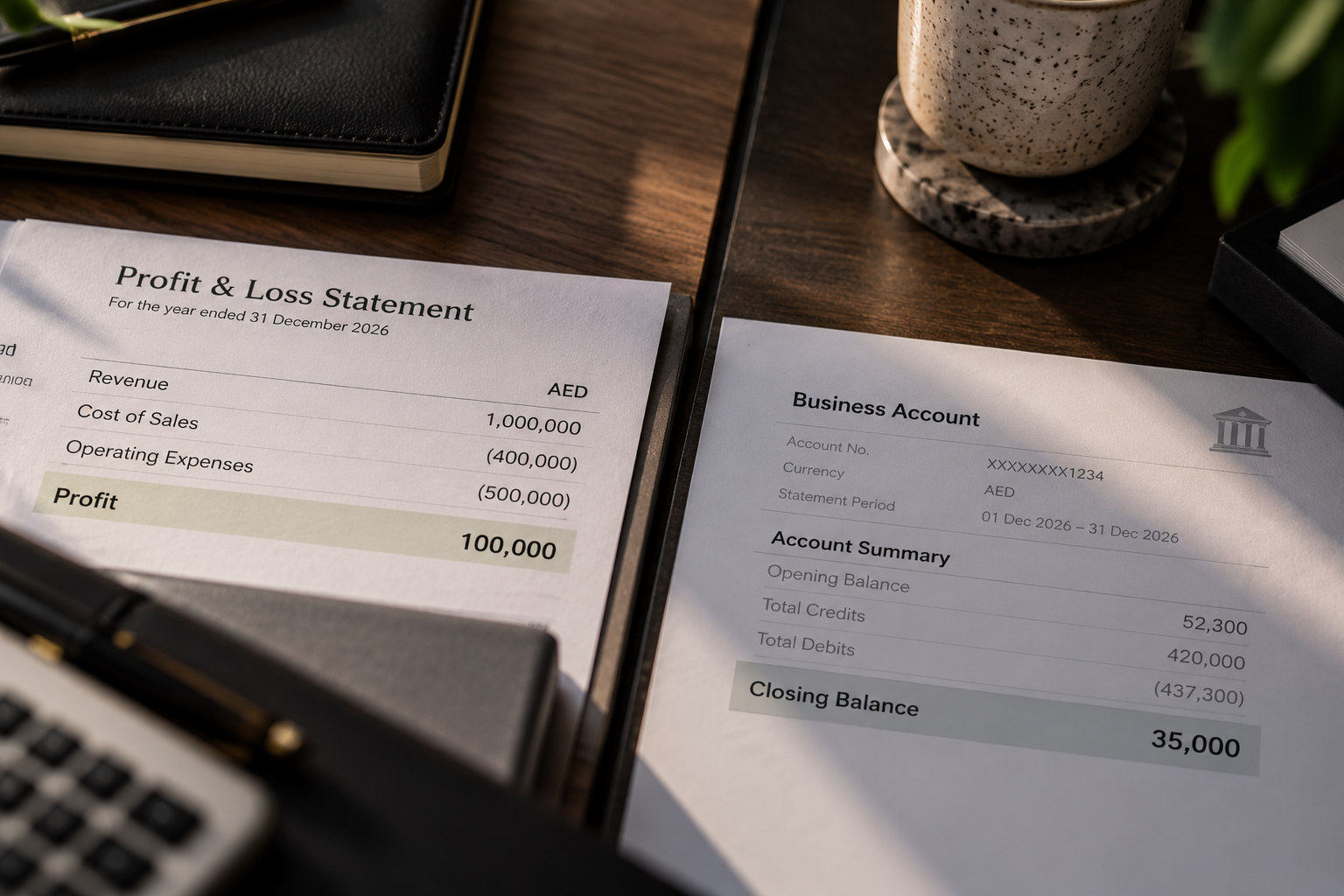

Your UAE business made AED 100,000 in profit this year.
So you check your bank account expecting to see something close to AED 100,000.
Instead, you see AED 35,000.
Naturally, you ask:
“If we made AED 100,000 profit, where did the money go?”
The answer is simple:
Profit is not the same as cash.
Your Profit & Loss tells you how profitable the business was. Your Cash Flow Statement explains what happened to the actual money.
You Didn’t Necessarily Lose the AED 100,000
Imagine your business reports:
Revenue: AED 1,000,000
Expenses: AED 900,000
Accounting Profit: AED 100,000
It is tempting to think that AED 100,000 should now be sitting in your bank account.
But cash may have been tied up in:
- Unpaid customer invoices
- Inventory
- Equipment and other assets
- Supplier deposits
- Loan repayments
- Tax and other liabilities
- Owner related transactions
The business can therefore be profitable while having significantly less cash available.
Where Could the Cash Have Gone?
1. Customers Still Owe You
Suppose you have AED 200,000 in outstanding customer invoices.
The sales may already be included in revenue, but the cash hasn’t reached your bank account yet.
This is why businesses should monitor:
- Total receivables
- Overdue invoices
- 90+ day balances
- Average collection period
If receivables keep increasing, your business may be generating sales without generating enough cash.
2. Cash Is Sitting in Inventory
This is particularly important for trading, retail, e-commerce and other stock-heavy businesses.
Imagine you purchase AED 300,000 of inventory.
The cash leaves the bank when you pay for the stock, but the products may not be sold for weeks or months.
The money hasn’t necessarily been lost.
It has simply moved from:
Bank → Inventory
The real question is:
“How much of our cash is tied up in stock that isn’t moving?”
3. You Bought Business Assets
Your business may have purchased:
Computers
Equipment
Vehicles
Furniture
Machinery
Office improvements
Suppose you spend AED 15,000 on equipment.
Your bank balance falls immediately.
But depending on the applicable accounting treatment, the asset may be recognised on the Balance Sheet and depreciated over time rather than appearing as an immediate AED 15,000 expense in the P&L.
So:
Cash ↓
does not necessarily mean:
Profit ↓ by the same amount
4. You Repaid Debt
Suppose the business made:
Profit: AED 100,000
But also repaid:
Loan principal: AED 20,000
The bank balance falls by AED 20,000.
Principal repayment is not treated in the same way as an ordinary operating expense in the profit calculation.
This is another reason why:
Profit ≠ Cash Available
5. Some Cash Is Already Committed
Your bank balance may also include money needed for upcoming:
VAT payments
Corporate Tax liabilities
Payroll
Supplier payments
Accrued expenses
So even if your business has AED 100,000 in the bank, it doesn’t automatically mean you have AED 100,000 available to spend.
Business owners need to distinguish between:
Cash Balance
and
Cash Available After Commitments
6. Cash May Have Left the Business
Another possibility is that money was taken out of the business.
Depending on the company’s legal structure and transaction, this could include:
Owner drawings
Dividends where applicable
Repayments to the owner
Personal expenses paid by the business
These transactions can reduce the company’s cash even when the business remains profitable.
This is also why business and personal finances should be kept properly separate.
The AED 100,000 Profit Example
Let’s say your business reports:
Accounting Profit: AED 100,000
During the same period, you also see:
- Receivables increasing
- Inventory increasing
- Equipment purchased
- Loan principal repaid
- Owner or other financing transactions
The result?
Your closing cash can be significantly different from your accounting profit.
That’s not necessarily an accounting error.
It is the normal difference between profit and cash flow.
Profit Up, Cash Down: Should You Worry?
Consider this:
2025
Revenue: AED 800K
Profit: AED 70K
Cash: AED 150K
2026
Revenue: AED 1.2M
Profit: AED 100K
Cash: AED 60K
Revenue increased.
Profit increased.
But cash fell significantly.
This could happen because growth is consuming working capital. Customers may be paying more slowly, inventory may have increased, or the business may be investing heavily in expansion.
Growth is positive, but growth without sufficient cash can create pressure.
7 Numbers That Explain Your Cash Position
If you’re trying to understand why profit doesn’t match your bank balance, review:
1. Net Profit
How much did the accounts report?
2. Accounts Receivable
How much money are customers still holding?
3. Inventory
How much cash is tied up in stock?
4. Accounts Payable
How much do you currently owe suppliers?
5. Capital Expenditure
How much cash went into business assets?
6. Debt Repayments
How much cash was used to reduce borrowing?
7. Owner Transactions
How much cash left the business through owner related activity?
These numbers give you a much clearer picture than looking at profit alone.
Your Bank Balance Isn’t Your Profit
These numbers answer different questions:
| Number | What It Tells You |
| Revenue | How much income the business generated |
| Profit | What remains after relevant income and expenses |
| Bank Balance | Cash currently held in the accounts |
| Cash Flow | How cash moved into and out of the business |
They can all be different.
And that’s completely normal.
The problem begins when business owners treat them as the same thing.
What Should You Review Every Month?
A useful monthly financial review should include:
Profit & Loss
Are we profitable?
Balance Sheet
What do we own and owe?
Cash Flow
Where did the cash move?
Receivables
Who owes us money?
Payables
Who do we owe?
Working Capital
How much cash is tied up in the operating cycle?
Cash Forecast
What could our cash position look like over the next 30, 60 and 90 days?
This turns accounting from a historical record into a management tool.
Ask Your Accountant This One Question
Don’t only ask:
“What’s our profit?”
Ask:
“Show me why our profit doesn’t match our cash.”
A proper financial review should help bridge the two by showing:
Opening Cash
- Operating Cash Flow
- Investing Activities
- Financing Activities
- Other Cash Movements
= Closing Cash
Once you understand this bridge, the mystery becomes much easier to solve.
When Should You Investigate Further?
Pay attention when you see:
- Revenue increasing but cash decreasing
- Receivables growing faster than sales
- Inventory growing faster than revenue
- Repeated negative operating cash flow
- Debt repayments consuming significant cash
Large unexplained differences between accounting records and bank balances
These patterns can point to working capital or financial management problems that need attention.
Frequently Asked Questions
1. Why don’t I have AED 100,000 in the bank if my business made AED 100,000 profit?
Because profit and cash are different. Cash may be tied up in receivables, inventory or assets, or used for debt repayments, liabilities and other transactions.
2. Can a UAE business be profitable but have low cash?
Yes. Slow customer collections, high inventory, debt repayments and major investments can all reduce available cash.
3. What is the difference between profit and cash flow?
Profit measures financial performance under the applicable accounting rules. Cash flow tracks the actual movement of money into and out of the business.
4. Can buying equipment reduce cash without reducing profit by the same amount?
Yes. Depending on the applicable accounting treatment, a capital asset may be recognised on the Balance Sheet and depreciated over its useful life.
5. How often should a UAE business review cash flow?
Monthly monitoring is a useful baseline for many businesses. Companies with rapid growth, high receivables, significant inventory or substantial debt may need more frequent reviews.
6. What should I ask my accountant when profit and cash don’t match?
Ask for a clear profit to cash reconciliation showing how accounting profit relates to operating cash flow and how investing, financing and other transactions affected the closing cash balance.
Conclusion
If your UAE business made AED 100,000 in profit, but you can’t see AED 100,000 in the bank, it doesn’t automatically mean something has gone wrong.
The money may be sitting in receivables, inventory or assets, or it may have been used for debt, liabilities or other transactions. The important question is not simply “Where did my profit go?” but “What happened to the cash generated by my business?” Once you can answer that, you can make much better financial decisions.
Know Where Your Business Money Is Going
At Evolve Accountants, we help UAE businesses look beyond the profit figure and understand the numbers behind their business.
From bookkeeping and financial reporting to cash-flow analysis and CFO services, our team can help you monitor working capital, identify financial pressure and understand why reported profit may not match available cash.
Book a Financial Review with Evolve Accountants and get a clearer picture of where your business cash is actually going.
Evolve Accountants
UAE Tax & Financial Experts