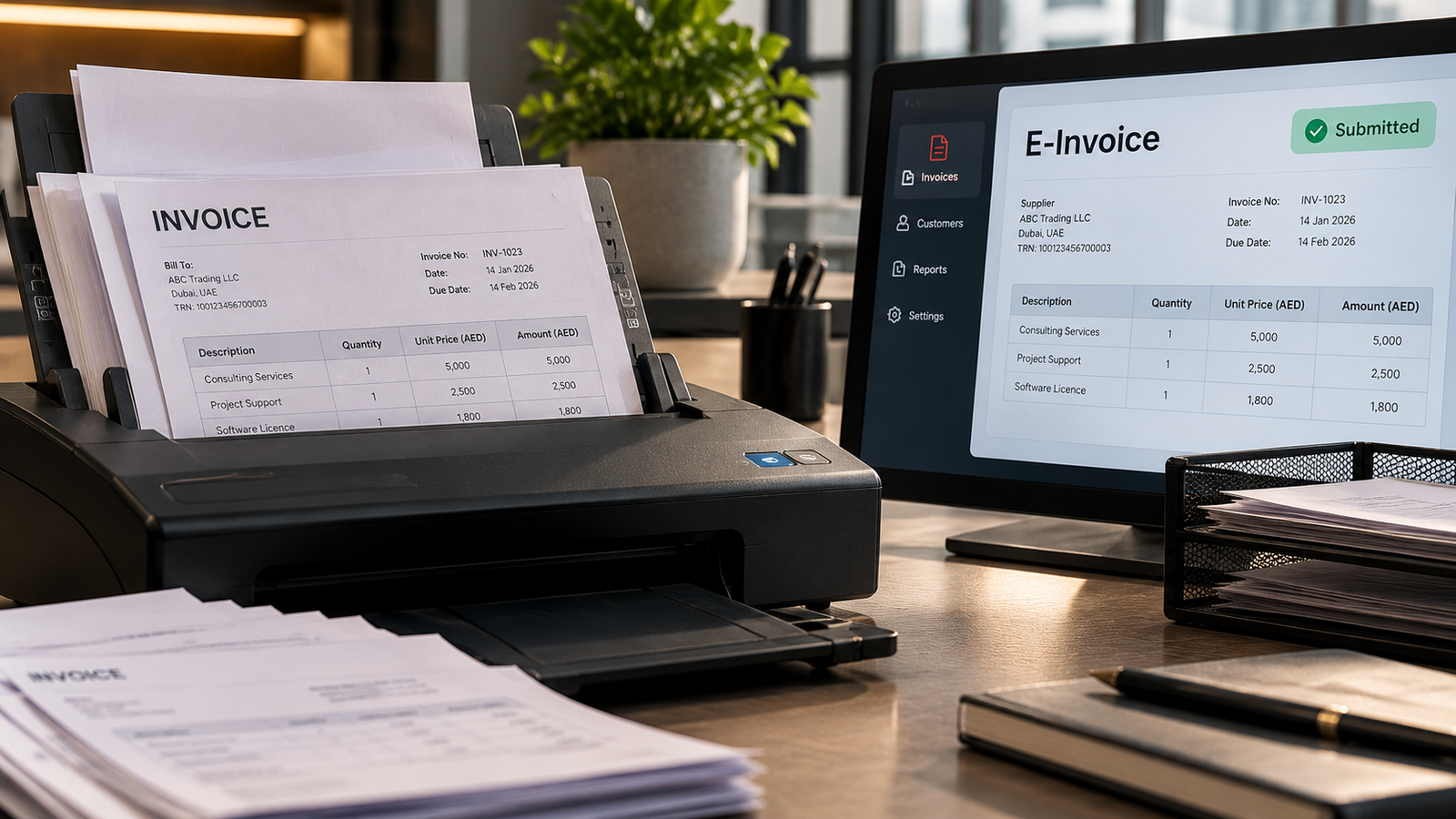

How Much Time Does Your Business Spend on One Invoice?
Here’s a simple question for every UAE business owner:
How many minutes does your business spend creating, checking, sending, recording and filing one invoice?
Five minutes? Ten? Twenty?
Now multiply that by 500 invoices a month.
Suddenly, invoicing is no longer a small administrative task. It becomes a recurring cost in employee time, processing and corrections.
This is where UAE E-Invoicing could make a significant difference.
The UAE Ministry of Finance says E-Invoicing is designed to reduce manual intervention, improve efficiency and reduce invoice processing costs. Its official portal states that countries implementing E-Invoicing have achieved invoice processing cost reductions of up to 66% when implemented correctly.
That does not mean every UAE business will save 66%.
The actual saving depends on your invoice volume, current workflow, accounting system and how much manual work your team performs.
So the better question is:
How much time is your current invoicing process actually costing you?
Manual Invoicing Looks Cheap Until You Count the Hours
A typical manual process can involve:
Create invoice
↓
Check customer and VAT details
↓
Save and send invoice
↓
Enter information into accounting software
↓
File the invoice
↓
Match the payment
↓
Correct errors if necessary
Each individual step may only take a few minutes.
But across hundreds or thousands of invoices, those minutes add up quickly.
For example, imagine a UAE business processes:
300 invoices per month
If each invoice takes an average of:
10 minutes
That equals:
3,000 minutes or 50 hours every month.
Over a year, that’s:
600 hours.
That’s 15 full 40 hour working weeks spent on invoice processing alone.
And this doesn’t include time spent correcting errors, answering customer queries or searching for old records.
What Changes With E-Invoicing?
E-Invoicing is not simply sending a PDF invoice by email.
The UAE Ministry of Finance defines an eInvoice as structured invoice data that is issued and exchanged electronically between a supplier and buyer and reported electronically to the Federal Tax Authority. PDFs, Word documents, images, scanned invoices and email-only invoices do not qualify as eInvoices.
The UAE system is built around Accredited Service Providers and structured electronic data exchange.
This can reduce several manual steps involved in creating, sending, validating, recording and reporting invoices.
Instead of:
Create → PDF → Email → Re-enter → File
the process can become much more integrated.
The exact workflow will depend on the business’s accounting system and chosen Accredited Service Provider.
Manual Invoicing vs E-Invoicing
| Process | Manual Invoicing | E-Invoicing |
| Invoice creation | Often manual | Can be automated |
| Customer data | Manually entered | Pulled from system |
| VAT information | Manual checks | Structured data and validation |
| Invoice delivery | Email/PDF | Electronic exchange |
| Data entry | Often repeated | Can be reduced |
| Validation | Manual or system dependent | Structured validation |
| Record keeping | Manual filing | Digital records |
| Payment matching | Often manual | Can be integrated |
| Error correction | Human intervention | Automated checks can reduce errors |
The goal is not to eliminate accounting work.
It is to reduce repetitive work that does not require manual intervention.
The Biggest Saving May Come After the Invoice Is Created
Many businesses focus only on how long it takes to create an invoice.
But invoice creation is only one part of the process.
Finance teams may also spend time:
- Correcting invoice information
- Responding to customer queries
- Entering invoices into multiple systems
- Matching payments
- Searching for records
- Preparing information for accountants
- Supporting VAT reporting
This is where automation can create a larger efficiency gain.
The Ministry of Finance identifies reduced processing time, fewer errors, improved cash flow, better financial visibility and simplified compliance among the potential benefits of E-Invoicing.
What About Errors?
Manual invoicing also creates the possibility of repeated errors.
Imagine a business processes:
500 invoices per month.
If just 2% require correction, that’s:
10 invoices every month.
A correction might involve finding the original invoice, identifying the problem, issuing a revised invoice, updating accounting records and communicating with the customer.
Structured electronic invoicing can reduce some of these errors through standardization and validation.
The Ministry of Finance specifically highlights built-in validations and controls as a way E-Invoicing can reduce errors and support faster invoice processing.
The 66% Figure Needs Context
The UAE Ministry of Finance cites up to 66% reduction in invoice processing costs based on the experience of countries that have implemented E-Invoicing successfully.
But businesses should not treat 66% as a guaranteed saving.
Consider two companies.
Business A
Uses integrated accounting software and already has automated invoice creation.
Its additional savings may be relatively limited.
Business B
Uses:
Excel → PDF → Email → Manual Entry → Manual Filing
It may have significantly more repetitive work that can potentially be automated.
The starting point matters.
So instead of asking:
“Will E-Invoicing save 66%?”
ask:
“How much manual work exists in our current process?”
How Much Could You Actually Save?
Let’s use an illustrative example.
A business processes:
500 invoices per month
Current average processing time:
12 minutes per invoice
That’s:
6,000 minutes
or:
100 hours per month.
If a new workflow reduces the average workload by 40%, the business could potentially save:
40 hours per month
or:
480 hours per year.
That’s equivalent to 12 full 40 hour working weeks.
These numbers are illustrative, not a regulatory benchmark. Actual savings will depend on the business’s systems, invoice volume and existing processes.
The calculation is simple:
Invoices × minutes per invoice = monthly processing time
Then compare your current process with the expected automated process.
E-Invoicing Can Also Support Cash Flow
Time savings are not the only potential benefit.
The Ministry of Finance says standardizing and automating invoice creation and exchange can reduce errors and deliver invoices to buyers in near real time, creating an opportunity for faster payment and better working capital management.
This does not mean every customer will suddenly pay faster.
But removing administrative problems can reduce delays such as:
“We didn’t receive the invoice.”
“The invoice details are incorrect.”
“Please send the invoice again.”
Fewer processing issues can create a smoother route from invoicing to collection.
What Does E-Invoicing Mean for VAT?
E-Invoicing is also relevant to tax and accounting processes.
Under the UAE framework, invoice tax data is reported to the FTA through Accredited Service Providers. The Ministry of Finance says this can facilitate the pre-population of certain VAT return fields and support more efficient compliance processes.
However, E-Invoicing does not mean businesses can stop reviewing their VAT treatment.
Businesses still need appropriate accounting controls, accurate tax treatment, reconciliations and financial reporting.
Who Can Benefit Most?
E-Invoicing is likely to have the greatest operational impact on businesses with:
High Invoice Volumes
The more invoices you process, the more repetitive work there is to automate.
Multiple Finance Staff
Reducing handoffs can improve workflow efficiency.
Large Receivables
Faster invoice exchange can help remove administrative collection delays.
Multiple Branches
Digital processes can reduce duplication and improve visibility.
Growing Businesses
Automation can prevent administrative work from growing at the same rate as sales.
A business issuing 10 invoices a month will naturally have less time to save than one issuing 2,000.
UAE E-Invoicing Timeline
The UAE is introducing E-Invoicing through a phased implementation.
For businesses with annual revenue of AED 50 million or more, the Ministry of Finance’s current framework sets an implementation date of 1 January 2027, with the deadline for appointing an Accredited Service Provider having been extended to 30 October 2026.
For businesses with annual revenue below AED 50 million, the current deadline to appoint an Accredited Service Provider is 31 March 2027, with mandatory implementation from 1 July 2027.
Businesses can also implement E-Invoicing voluntarily from 1 July 2026, subject to the applicable technical requirements.
This means preparation should begin before the mandatory deadline.
Don’t Start With Software. Start With Your Process.
One of the biggest mistakes businesses can make is asking:
“Which E-Invoicing software should we buy?”
before understanding the current process.
Start with five questions:
- How many invoices do we issue each month?
- How many minutes does each invoice take?
- How many people handle an invoice?
- How many invoices require corrections?
- How much time is spent matching payments and finding records?
Once you understand those numbers, you can assess what your accounting system and Accredited Service Provider actually need to handle.
Your E-Invoicing Efficiency Check
Take your previous month’s invoices and calculate:
Total invoices: ______
Average minutes per invoice: ______
Total monthly processing hours: ______
Corrected invoices: ______
Average correction time: ______
Payment matching hours: ______
Then calculate:
Current monthly workload – Expected automated workload = Potential time saved
You can then multiply the hours saved by the relevant employee cost to estimate the potential financial value.
This gives your business a much more useful starting point than simply asking how much E-Invoicing software costs.
The Real ROI of E-Invoicing
The return should not be measured only by software cost.
Consider:
Time Saved
How many finance hours can be recovered?
Fewer Errors
How much correction and rework can be reduced?
Faster Processing
How quickly can invoices move through the business?
Better Cash Flow
Can administrative delays in collections be reduced?
Better Records
How quickly can finance retrieve transaction data?
Compliance Efficiency
Can manual tax and reporting processes be simplified?
The Ministry of Finance identifies efficiency, cost reduction, cash flow improvement, financial visibility and simplified compliance among the potential benefits of E-Invoicing.
So, How Much Time Can a UAE Business Save?
There is no universal number.
A business issuing 50 invoices a month will have a very different result from a business issuing 5,000.
A company already using integrated accounting software will also have a different starting point from a business relying heavily on spreadsheets, PDFs and manual data entry.
The basic principle is simple:
More invoices + more manual steps = greater opportunity for automation.
The UAE Ministry of Finance cites potential invoice processing cost reductions of up to 66%, but your actual result depends on your current workflow.
The smartest approach is to calculate your baseline now and identify where your finance team is spending time unnecessarily.
Frequently Asked Questions
1. Is E-Invoicing faster than manual invoicing?
It can be. E-Invoicing is designed to reduce manual intervention and automate parts of invoice creation, exchange, validation and reporting.
2. How much can UAE businesses save with E-Invoicing?
The Ministry of Finance cites potential invoice processing cost reductions of up to 66% based on international experience. This is not a guaranteed saving for every business.
3. Is a PDF invoice an eInvoice?
No. PDFs, Word documents, images, scans and invoices sent only by email are not considered eInvoices under the UAE framework.
4. Will E-Invoicing eliminate accounting work?
No. Businesses will still need bookkeeping, reconciliations, VAT review, financial reporting and appropriate accounting controls.
5. Can E-Invoicing help businesses get paid faster?
It can reduce administrative delays by improving invoice exchange and validation. However, it does not guarantee that customers will pay faster.
6. When does mandatory E-Invoicing start for businesses below AED 50 million revenue?
For businesses within scope and below AED 50 million annual revenue, mandatory implementation is currently scheduled for 1 July 2027, with an Accredited Service Provider to be appointed by 31 March 2027.
7. Does a business need to replace its accounting software?
Not necessarily. Businesses should first assess whether their existing accounting system can support the required E-Invoicing workflow and integrate with an Accredited Service Provider.
Conclusion
Manual invoicing rarely feels expensive when you look at one invoice. But when minutes become hundreds of hours across the year, the cost becomes significant. UAE E-Invoicing is designed to reduce manual intervention, improve data quality and streamline invoice processing. Instead of waiting for the mandatory deadline, businesses should calculate their current invoicing workload now and identify where automation can create the greatest operational value.
How Much Is Manual Invoicing Really Costing Your Business?
At Evolve Accountants, we help UAE businesses understand the numbers behind their accounting and financial processes.
Our team can review your invoicing workflow, accounting systems, bookkeeping processes and financial operations to identify where manual work is consuming valuable time and help you prepare for UAE E-Invoicing.
Don’t automate blindly. First, understand what your current process is costing you.
Book an Accounting & E-Invoicing Readiness Review with Evolve Accountants today.
Evolve Accountants
UAE Tax & Financial Experts