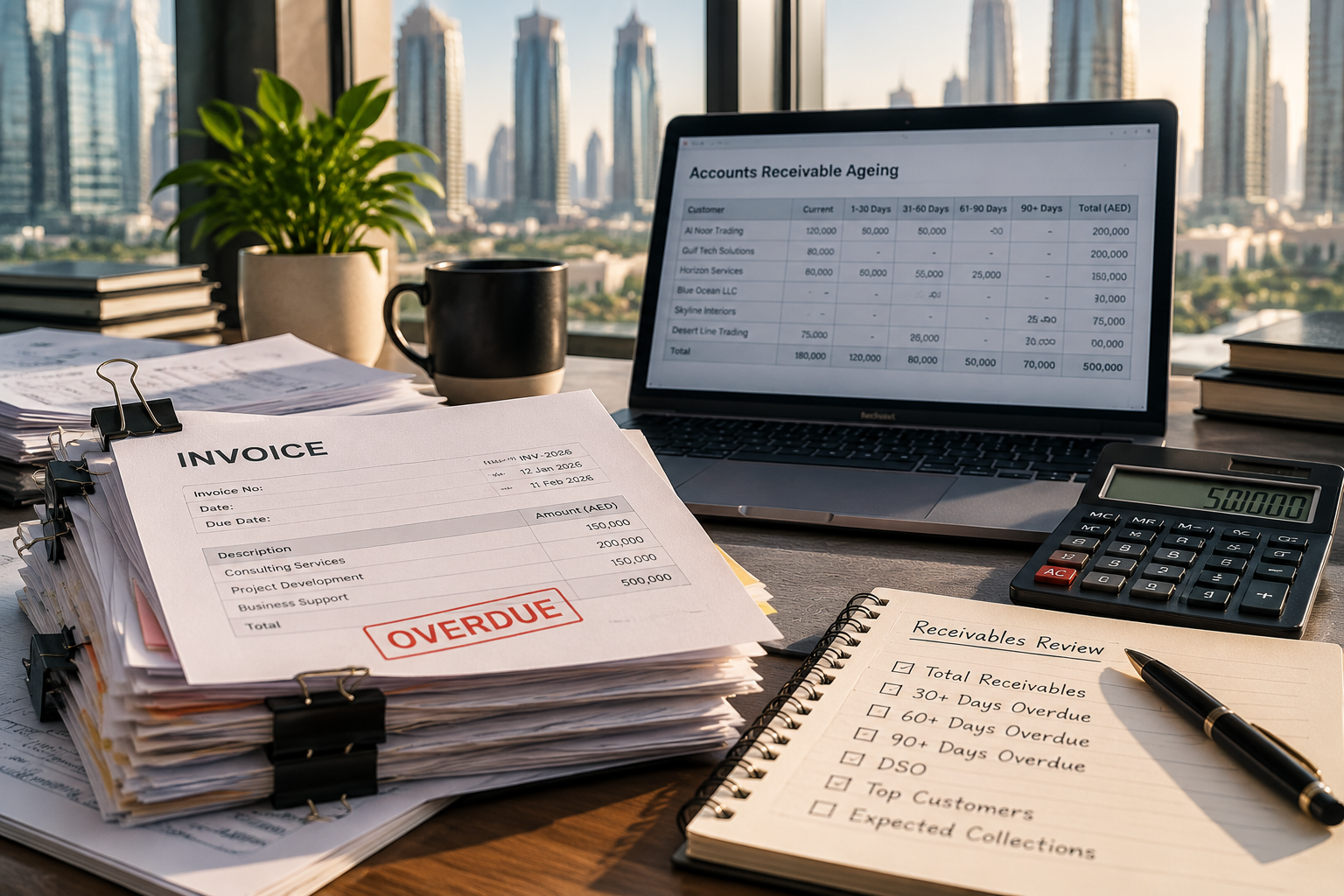

Your UAE business has closed the month.
Revenue looks strong. Profit looks healthy.
Then you check the balance sheet:
Accounts Receivable: AED 500,000
Your customers owe you half a million dirhams.
Sounds positive, right?
Not necessarily.
The important question is:
When will that AED 500,000 actually reach your bank account?
Customers owing you money is not the same as having money in the bank. Receivables can represent healthy business activity, but they can also create cash flow pressure when customers take too long to pay.
Revenue Is Not Cash
Imagine your business generates:
AED 2M revenue
AED 300K profit
AED 500K receivables
The business may be profitable, but the AED 500K is not available to spend until customers actually pay.
Meanwhile, you still need to cover:
- Payroll
- Suppliers
- Rent
- Operating costs
- Financing
- Other business obligations
This is why a business can report a healthy profit and still experience cash flow problems.
Profit shows performance. Cash flow shows available cash.
Is AED 500K in Receivables Good or Bad?
There is no universal number that makes receivables too high.
Consider two businesses:
Business A
Revenue: AED 10M
Receivables: AED 500K
Receivables represent around 5% of annual revenue.
Business B
Revenue: AED 2M
Receivables: AED 500K
Receivables represent 25% of annual revenue.
Same receivable balance. Very different situations.
You therefore need to look at the number alongside:
- Revenue
- Payment terms
- Collection history
- Cash reserves
- Customer concentration
- Invoice ageing
DSO: The Number You Should Know
Days Sales Outstanding (DSO) estimates how long a business takes to collect payment from customers.
A simplified calculation is:
Accounts Receivable ÷ Credit Sales × Number of Days
Suppose your business has:
AED 500K receivables
AED 6M annual credit sales
Your approximate DSO is around 30 days.
That may be reasonable if your customers are expected to pay within 30 days.
But if your DSO rises to 85 days while your contracts specify 30 day payment terms, you have a reason to investigate.
A rising DSO can indicate that customers are taking longer to pay and cash is becoming tied up in receivables.
Ageing Tells You the Real Story
Looking only at total receivables can hide a problem.
Suppose your AED 500K is divided like this:
| Invoice Age | Amount |
| Current | AED 180K |
| 1–30 days overdue | AED 120K |
| 31–60 days overdue | AED 80K |
| 61–90 days overdue | AED 50K |
| 90+ days overdue | AED 70K |
| Total | AED 500K |
Now the picture is clearer.
AED 180K is current, but AED 200K is already more than 30 days overdue.
The key question is no longer:
“How much do customers owe us?”
It becomes:
“How much can we realistically collect, and when?”
Invoices that remain outstanding for months deserve closer attention, particularly where there are disputes, missing documents or concerns about the customer’s ability to pay.
Who Owes You the Money?
Customer concentration matters too.
Imagine your total receivables are AED 500K, but AED 400K comes from one customer.
That creates a very different risk from having 25 customers owing AED 20K each.
If one major customer delays payment, your cash position can change significantly.
Your receivables report should therefore tell you both:
How much is owed?
and
Who owes it?
Payment Terms Can Create Cash Flow Pressure
Your payment terms can directly affect working capital.
Suppose you give customers 90 days to pay, while suppliers expect payment within 30 days.
You may have to pay employees, suppliers and operating expenses long before the customer pays you.
That creates a working capital gap.
This is why payment terms are not just a sales decision.
They are a financial decision.
Businesses should understand the cash flow impact before offering extended credit terms.
When Does AED 500K Become a Warning Sign?
The balance itself is not necessarily a problem.
Watch for these signs:
- Receivables growing faster than revenue
- DSO consistently increasing
- More invoices moving into the 90+ day category
- Customers regularly exceeding payment terms
- A large portion of receivables coming from one customer
- Increasing disputed invoices
- Cash declining despite reported profit
- Borrowing to cover delayed customer payments
These patterns can indicate that the business is generating sales but struggling to convert those sales into cash.
Your Monthly Receivables Check
A useful monthly report should track:
Total Receivables
AED X
Current Receivables
AED X
30+ Days Overdue
AED X
60+ Days Overdue
AED X
90+ Days Overdue
AED X
DSO
X days
Top Debtors
AED X
Expected Collections
AED X
This gives management a much clearer picture than simply knowing that customers owe AED 500K.
The 5 Questions to Ask
If your UAE business is owed AED 500,000, ask:
1. How old is the money?
Is it current or seriously overdue?
2. Who owes it?
Is the balance diversified or concentrated with one customer?
3. When should they pay?
Compare actual payments with contractual terms.
4. How much is realistically collectible?
Not every outstanding invoice carries the same level of certainty.
5. What does it mean for cash flow?
Can the business comfortably cover payroll, suppliers and operating costs while waiting for payment?
Profit Is Not the Finish Line
A business should not stop at:
“We made AED 500K profit.”
It should also ask:
- How much has been collected?
- How much remains outstanding?
- How old is it?
When will the cash arrive?
Because:
- Revenue is not cash.
- Profit is not cash.
- Receivables are not cash.
The strength of your business depends not only on how much you sell, but on how effectively you turn those sales into cash.
Frequently Asked Questions
Is accounts receivable an asset?
Yes. Accounts receivable generally represents money owed to the business by customers and is recorded as a receivable under the applicable accounting framework. Its collectability should also be assessed.
Is AED 500,000 in accounts receivable too much?
Not necessarily. It depends on revenue, payment terms, industry, customer behaviour and the business’s cash requirements.
What is DSO?
Days Sales Outstanding, or DSO, estimates how long a business takes to collect payment from customers after credit sales.
Why can a profitable business have cash flow problems?
Revenue and profit can be recognised before customers actually pay. Cash can also be tied up in receivables and other working capital.
How often should receivables be reviewed?
Monthly review is a useful minimum for many businesses. Businesses with significant receivables or long payment terms may need more frequent monitoring.
Conclusion
AED 500,000 in receivables is not automatically good or bad. What matters is how much you can collect, how quickly you can collect it and how that timing affects your cash flow. If invoices keep aging, DSO rises and cash keeps falling, your balance sheet may be hiding a problem that needs attention.
Know What Your Receivables Are Really Telling You
At Evolve Accountants, we help UAE businesses understand more than just their revenue and profit. Our accounting, bookkeeping and financial reporting services can help you monitor receivables, track working capital and understand where cash is being tied up.
Don’t just know how much customers owe you. Know when you can expect the money.
Evolve Accountants
UAE Tax & Financial Experts